Even though we were unable to go to the DRBC hearings last week, our friend photographer Roger Smith has shared his experience and pictures of the event with us. Here is his report from Honesdale, PA on February 22, 2011:
Each person commenting was given two minutes to speak. There were about 100 speakers. PhDs, local government, farmers, business owners, and many concerned individuals. Newspaper and TV coverage was present. Also security personnel was there, however there appeared to be no need for them at this hearing. Although each person said their name and some additional personal information, I did not know any of them until Josh Fox of Gasland spoke.
DRBC Draft Natural Gas Regulations Open for Comment through March 16, 2011
DRBC HEARINGS ARE THIS WEEK Please be there and bring your neighbors!
Feb. 22 – Honesdale H.S., 459 Terrace St., Honesdale, Pa. Feb. 22 – Liberty High School Aud., 125 Buckley St., Liberty, N.Y. Feb. 24 – Patriots Theater, 1 Memorial Dr., Trenton, N.J.
All are 1:30 p.m. to 5 p.m. and 6 p.m. to 9:30 p.m.
Two minutes allowed per person
Arrive 1 1/2 hours ahead to sign up to speak and get a seat
Bring signs to show our unity (no sticks)—visit DRN’s table for stickers
We need to come out and speak up at these Hearings to let the Commissioners know that the public interest in this issue and the proposed regulations is HUGE. It is very effective to show up in numbers and to speak on the record; when hundreds of people packed DRBC Hearings on gas issues in the past, it mattered. We wouldn’t have a gas drilling moratorium in place now if people hadn’t spoken up. PLEASE do what you can to come to one of the sessions.
Want to carpool to a hearing? Use this link http://drn.erideshare.com and password: water to access DRN’s private carpool site at eRideShare.com. You will need to become an eRideShare member (it’s free and easy) before adding or posting a ride.
A resident of Dimock, PA demonstrates what has happened to well water in the area. Credit: Re-ENERGIZE Buffalo
Natural gas companies are drilling throughout the Delaware River Watershed; the drilling process called "fracking" is contaminating our waterways, drinking water, ecosystems, and the communities near drilling sites with literally tons of highly toxic chemicals. The Delaware River provides water to 5% of the United States--that’s 15 million people in New York, Pennsylvania, New Jersey, and Delaware--and there is currently no regulation of these gas companies' practices. An in-depth study of the cumulative impacts of fracking needs to be conducted. However, in a set of draft rules the Delaware River Basin Commission has given these companies the greenlight to move ahead with drilling without regulation. Their rules do not address the impacts of fracking, set limits on gas development, or institute high enough standards to protect streams and communities. They rely heavily on flawed state regulations that are filled with exemptions and loopholes. The mandate of the DRBC is to prevent degradation of the exceptional water quality of the Delaware River. The public has until March 16th to comment on the DRBC’s draft rules. However, there are only three events left for public hearings. We really need to show up in numbers to make it clear to the DRBC that we will not stand for environmental policies that do not protect us. See below for dates, times and locations. You can also submit comments electronically.
Currently 34 states contain natural gas drilling sites, which is quickly contaminating drinking water through the process of hydraulic fracturing. As promised, here are a few ways you can put the heat on your politicians to pass safety regulations.
1. Call your representatives and senators and tell them to sponsor the FRAC Act currently making its way through Congress. The FRAC Act (Fracturing Responsibility and Awareness of Chemicals Act) is an attempt to amend the Safe Drinking Water Act to give the EPA authority over hydraulic fracturing. It would also require oil and gas drilling companies to disclose the chemicals used in fracking. Check out this article to learn more about the bill.
2. Get to know your local environmental groups to stay in touch with local legislation. The Environmental Working Group has a lot of great info about natural gas drilling around the country. And the Delaware Riverkeeper is keeping a vigilant watch over the situation with the Marcellus Shale here in PA. For a list of environmental organizations in your state, please visit Eco-USA.
3. Pennsylvanians: vote in the upcoming democratic primary. Joe Hoeffel is the only gubernatorial candidate who wants to put a moratorium on natural gas drilling in Pennsylvania. To read more about Joe's campaign to protect our drinking water visithis page on the Marcellus Shale.
4. Visit the GASLAND blog. Josh Fox has been taking his natural gas doc, GASLAND, on a grassroots tour to raise awareness of the issue, and has been updating the blog and Facebook page about drilling issues in the Marcellus Shale and around the country.
5pm TODAY is the deadline to voice your concern to the DRBC regarding the proposed Stone Energy Surface Water Withdrawal and Natural Gas Well Site.
Please email a statement that includes your address to: Paula.Schmitt@drbc.state.nj.us. Subject line should read: "Public Comment - Stone Energy Dockets."
Here's a sample letter you can use, compliments of the Delaware Riverkeeper.
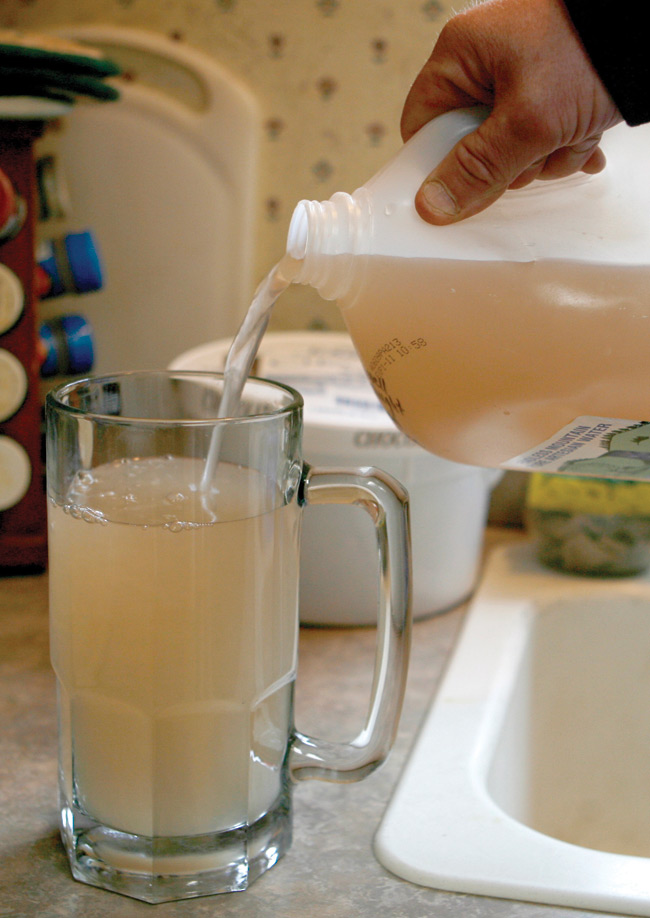
A resident of Dimock, PA pours water that came from his well after start of natural gas fracking. Credit: High Country News
I attended a very full screening of GASLAND last night at the Prince Music Theater. It was a mesmerizing, maddening and tragic expose of an environmental issue that I suspect is going to be one of the biggest environmental issues of our time: drilling for natural gas.
The story is not a new one in America's history, and the negligence (greed, secrecy, etc. etc.) of the natural gas industry and the government agencies that should be monitoring this industry in the name of public safety, can be added to a long list of ways that America is on a fast track to making our country completely unlivable.
The problem? Hydraulic fracturing or fracking--the method for extracting the enormous stores of natural gas currently embedded in geologic formations across this country--is extremely toxic. A lethal cocktail of chemicals (among them formaldehyde, pesticides and plastics) is mixed with hundreds of millions of gallons of water and forced underground to open up pockets of gas. What happens to this wastewater afterwards?* Who cares? The gas companies are making money, and that's the bottom line, right?
But what director Josh Fox uncovers is that this wastewater is contaminating the communities who reside near natural gas wells, and doing it an a alarming rate. Polluted, flammable tap water; sick pets and livestock; reports of chronic headaches; asthma, body pain and other illnesses in humans; the list is long and chilling.
And what kind of law could possibly exist in this great land of ours that makes it possible for the natural gas industry to get away with such atrocities? An Energy Policy Bill passed in 2005 by the Bush-Cheney administration. It provided tax incentives for energy production and exempted oil and gas producers from safety regulations specified in the Clean Water and Safe Drinking Water Acts. And so began an unregulated natural gas boom across the nation. Wild west style. It may be good for reducing our dependence on foreign oil (and the Axis of Evil), but it threatens to pollute our waterways, which--as Fox so poignantly illustrates in old footage of Woody Guthrie singing "This Land is Your Land"--are literally all connected.
Currently 34 states are impacted by the natural gas industry. One of the largest regions for drilling is right here in Pennsylvania and stretches across the Delaware River Basin, a watershed that provides water to over 15 million people across Pennsylvania, New Jersey and New York, 2 million of which are customers of the Philadelphia Water Department.
For ways you can make your voice heard about this issue, read our upcoming blog, "Tell Your Politicians No Fracking Way".
*To learn more about what actually happens to fracking wastewater, check out this informative blog about the fracking process from a resident of Hickory, PA.
This Saturday, April 10th, is a good day to get informed about a serious issue affecting Pennsylvanians' drinking water: drilling for natural gas. At 5:30, the Philadelphia Film Fest is screening GASLAND at the Prince Music Theater. And at 8:30, GASLAND director Josh Fox and Joe Hoeffel will host a Q&A about responsible gas drilling in the Marcellus Shale at Naked Chocolate Cafe.
We've heard fantastic things about GASLAND, which won the Special Jury Prize at this year's Sundance Film Fest. We've also had the pleasure of meeting Joe Hoeffel, the only democrat running for governor of PA with a progressive agenda. With four weeks until the primary, Saturday is great opportunity to learn more about Joe's stance on the environment and what it will take to get a progressive elected in November who will protect our drinking water.
About the Film: GASLAND follows filmmaker Josh Fox as he sets off on a 24-state journey to uncover the deep consequences of the United States' natural gas drilling boom after he discovers that Natural Gas drilling is coming to his area—the Catskillls/Poconos region of Upstate New York and Pennsylvania. What he uncovers is truly shocking—water that can be lit on fire right out of the sink, chronically ill residents of drilling areas from disparate locations in the US all with the same mysterious symptoms, huge pools of toxic waste that kill cattle and vegetation well blowouts and huge gas explosions consistently covered up by state and federal regulatory agencies. For more information about the film visit Gaslandthemovie.com.
The Marcellus Shale Region: The Marcellus Shale runs through the western region of Pennsylvania and contains largely untapped gas reserves. This area has produced natural gas for years, however, many gas production companies are now becoming interested in the Marcellus after only recently have figuring out a way to extract it from the region. Now gas drillers are looking to lease local land in an attempt to find and remove the gas. Marcellus Shale is thought to contain enough natural gas to supply the entire United States for two years. To learn more about the Marcellus Shale region visit marcellus-shale.us.
The Effects: Natural gas is a fossil fuel that is often promoted as "cleaner" than coal, but it has caused more cases of environmental illness than any other substance, even pesticides. The drilling process is called hydraulic fracturing. It involves millions of gallons of water and dozens of chemicals. Each well drilled can produce millions of gallons of chemical-laced, industrial waste water. Currently, the natural gas industry is not responsible for treating this waste water. To learn more about the negative effects of natural gas, please visit un-naturalgas.org.
The Campaign: Joe Hoeffel is the only PA gubernatorial candidate who is calling for a Moratorium on issuing more Marcellus Shale gas drilling permits until we know how to properly treat the waste water and meet the standards of the Safe Drinking Water and Clean Water Acts. Joe Hoeffel has earned support of environmental leaders and activists for his sound policies in the state house and congress. Joe Hoeffel will fight for responsible gas drilling with strong environmental regulations. To read more about his campaign, visit joehoeffel2010.com/environment/marcellus-shale.
Event Info: Screening hosted by Philadelphia Film Society. Tickets available for purchase one hour before show. For tickets to the Q&A benefit reception, visit tinyurl.com/gasland.