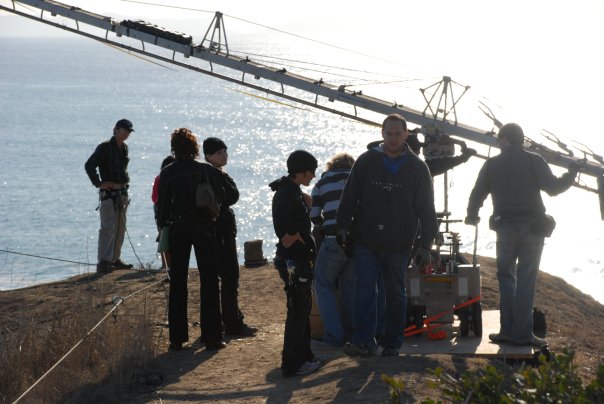
As a first assistant director on film productions, I always have two main goals in mind. Call them Carolina’s Golden Rules of AD-ing. If I don’t accomplish both, I have failed the team and the film:
- Regardless of what the “Film Gods” may throw at us, we MUST make our day!
- Without a happy, motivated crew, you cannot accomplish #1. So listen to the crew’s needs, treat them well, and above all get them home happy and on time.
 r graduate thesis film, The Things You Lose in the Ocean, I was excited for several reasons. First I love helping other women in the director’s chair. (I love you too guys, but I get gitty when it comes to girl power.) Secondly, the producer, Laura Avila-Tascan, contacted me and told me that we were going to try our best to make this an environmentally friendly production.
I was energized by the idea of lessening the carbon footprint that this film was going to leave. Finally the opportunity to marry two things I feel passionate about, the health of the earth and film. I also saw the opportunity to educate crewmembers in the process so that they can implement some of these ideas on future productions.
For those of you interested, here’s a quick breakdown of the scope of the project:
Operating Budget: $40,000
Format: 35mm
Length: 27 minutes
Crew: approx. 50
Production Days: 11
Talking about going green was great. But I would be lying if I were to tell you that I wasn’t nervous about whether our green attempt was going to infringe on my golden rules as an AD. I didn’t want the crew to be up-set and I sure didn’t want the production to be slowed down. It took some getting use to on set but despite my trepidation, everyone adapted just fine.
Here are the four steps we took toward sustainable filmmaking.
1. Water Bottles
Laura our producer ordered stainless steel water bottles for the entire crew from Customearthpromos.com. I still use mine! The pricing starts at around $3.50 per bottle. All said and done our water bottles cost about $6.00 a piece. The only catch is that you need to purchase at least 100. For small productions this might be a problem but with the film title printed on the side, extras make a great marketing tool to hand out on the festival circuit. We chose to go with the bottle with the Carabiner. It obviously helped everyone keep track of their water, and who doesn’t LOVE to have something to hook on to their belt on a film set.
To fill up the bottles we used old school water jugs (like the ones used in football practice) and filled them with tap water and ice on location. We bought four jugs. We kept two at base camp, and transported the other two to set if it was a long walking distance. When the jugs on set got low, we would radio to base camp and two PA’s would swap them out.
2. Carpool

Southern California is a driving culture, and we shot all over from Altadena to San Pedro to Lake Elsinore. Most of the crew lived in Orange County and Los Angeles, so travel time to set everyday could be upwards of two hours depending on traffic. Shooting on location, you’re always nervous that some crew will be late because of unfamiliarity with the area. So we organized a centrally located carpool with production vehicles. In an attempt to discourage people from driving their own cars, we reminded them that parking would be limited at the areas that we were shooting.
The carpool not only saved fossil fuel, but also built community. We had great conversations while we traveled to and from set. Furthermore it gave us an opportunity to have meetings even before we arrived on set. Efficiency-LOVE THAT!
3. Recycling
We took the suggestion from the California Film Commission’s Green Resource Guide and labeled our trash receptacles “LANDFILL”. It really made people think twice before they threw something away. Right next to the trash we placed the recycling bins with a giant sign that read, “Thank You, Love Mother Earth”. It almost became a game on set. We recycled paper, plastic and glass. We could have paid a service to come and pick it up, but to save money we didn’t have, we dropped it off at the recycling center ourselves at the end of each production day.
4. Food
Meat pro
 duction is responsible for about 20% of greenhouse gases. This is where my responsibility to a happy crew came into conflict with my beliefs. I would have been totally content if all of our meals were vegetarian, because I am one. But we compromised and cut the meat in half (even though less than half of our crew was vegetarian) and offered one vegetarian option and one meat option for hot meals on set. We budgeted the amount of food well and never really had any large amounts of leftovers, which is great for production cost. If we had leftovers we could have contacted Angel Harvest, a service that picks up leftover catering and donates it to homeless shelters. For leftover unopened crafty in the LA area you can also donate it to America’s Second Harvest.
So if you're nervous that making a few green changes on-set might throw off your production, my suggestion is to just go for it! We only put into practice a few initiatives because we feared the production would suffer. But if a group of grad students who aren’t seasoned filmmakers can do it, your production team can do it. Jump in with both feet, because your crew will get behind you, and when you are watching your film on the big screen you’ll feel great about what you’ve accomplished both with the film and with the mindful production.
Carolina Roca-Smith is a filmmaker currently completing her MFA in film production at Temple University. She has directed several short films including, “Members Only”, distributed by Frameline and available for purchase or rent on the “Fun in Girl’s Shorts” compilation DVD.


